

You’ve probably mixed Frappe vs Frappuccino at some point without even noticing. Asked for a “frappe” somewhere and got a blank look back. Or called something a “Frappuccino” when it wasn’t even close. Makes sense, honestly. The names sound nearly identical, and both drinks land cold, foamy, with something sweet piled on top.
We’ve made both more times than we can count:
- One with a jar and a spoon
- The other with an actual blender and way too much ice
Give this a read and the difference stops being confusing.
| Frappe | Frappuccino | |
|---|---|---|
| Where it’s from | Greece | Starbucks, USA |
| Made with | Instant coffee and water | Coffee, milk, ice, syrup |
| Texture | Watery with a foamy top | Thick and blended smooth |
| Calories | Usually under 150 | Often 240 or more |
| Caffeine | Always has some | Depends on the flavor |
What Is a Frappe vs a Frappuccino?
A frappe is instant coffee with cold water and a bit of sugar, shaken hard till it’s foamy on top and stays watery underneath. No milk required, though plenty of people add a splash. It’s a Greek drink through and through, and if you order one in Athens, that’s exactly what lands in front of you.
A Frappuccino is Starbucks’ invention; the name is legally theirs. It’s espresso or brewed coffee blended with milk, ice, and flavored syrup till it turns into something closer to a coffee milkshake than a coffee drink.
Some versions skip the coffee entirely and use a crème base instead, which is how you end up with a “coffee” drink that has zero caffeine in it.
Here’s the part that confuses many people. As Starbucks owns the word Frappuccino, almost every other coffee shop calls its blended iced coffee a frappe instead. The confusion isn’t your fault. The industry built it that way.
Where Frappe and Frappuccino Actually Come From
Most people figure one drink grew out of the other. It’s actually the opposite. The real story explains almost every difference you’ll find between them.
Origin of Frappe
Start with the frappe. In 1957, a Nescafé rep named Dimitris Vakondios was working a trade fair in Thessaloniki. He wanted his usual instant coffee during a break, but there was no hot water anywhere near his booth that day. So he improvised, shaking instant coffee with sugar and cold water together in whatever container he had lying around.
It foamed up nicely, tasted fine, and within a few years had spread through cafes all across Greece. That same shaken method, no blender involved, is still how a proper frappe gets made.
Origin of Frappuccino
The Frappuccino’s roots sit in a small Boston chain called The Coffee Connection. Back in the early ’90s, this shop was already selling a coffee-milkshake hybrid. Starbucks acquired the chain in 1994, mainly to get the recipe and the name, and pushed the Frappuccino out across the country in 1995. No other company has been allowed to call a drink that since.
These weren’t two takes on the same idea. Different continents, different decades, different problems entirely. A missing kettle started one. A business acquisition started the other.
Ingredients and Equipment You’ll Need for Frappe vs Frappuccino
Neither drink asks for anything fancy, which is honestly the best part about making them at home:
For a frappe:
- Instant coffee, Nescafé is the traditional choice
- Sugar, optional and entirely up to your taste
- Cold water
- Ice cubes
- A shaker, a jar with a tight lid, or a milk frother in a pinch
- Milk, optional
For a frappuccino:
- Brewed coffee or a shot of espresso, cooled
- Milk, dairy or plant-based both work
- Sweetener or flavored syrup
- Ice, a good amount of it
- A blender that can actually crush ice without straining
- Whipped cream, if you’re going all in
The blender is really the only piece of equipment that matters here. A weak one will give chunky ice instead of that smooth, sippable texture Frappuccinos are known for. If yours struggles, we have a solution for that: pulse it in short bursts instead of running it straight through, giving the blades a break and crushing the ice more evenly.
Basic Homemade Frappe Recipe
This is the shaken version, close to what you’d get in a Greek café:
What you’ll need
- 2 teaspoons instant coffee
- 1 to 2 teaspoons sugar, adjust to taste
- 2 tablespoons cold water
- Ice cubes
- Cold milk or water to top off
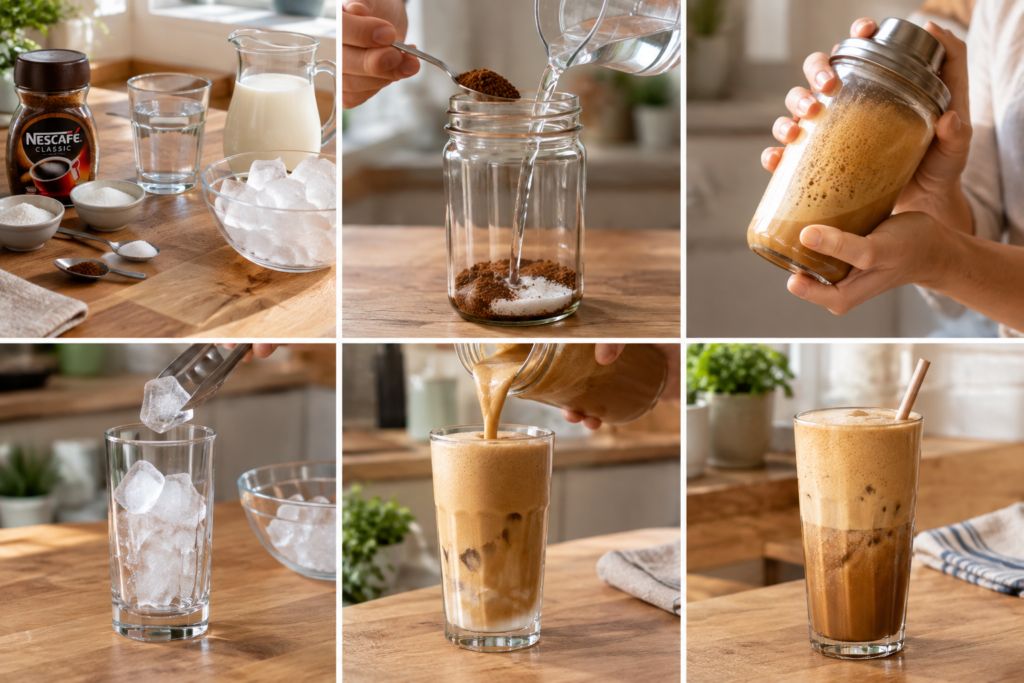
Steps
- Add the instant coffee, sugar, cold water to a shaker or a jar with a lid that seals properly
- Shake hard for about 30 seconds, and remember, you’re not stirring here, you’re building foam, so put some effort into it
- Fill a tall glass with ice
- Pour the foam over the ice
- Top off with cold water, milk, whichever you prefer, and give it a light stir
We’ve tried this with a milk frother rather than shaking by hand, and it works, but the foam doesn’t hold quite as long. If you make frappes occasionally, the jar method is honestly less hassle to clean.
Basic Homemade Frappuccino Recipe
This one is meant to come out thick and leans more towards a blender instead of a shaker:
What you’ll need
- 1 shot of espresso or half cup of strong brewed cold coffee
- ¾ cup milk
- 1 to 2 tablespoons sugar or flavored syrup
- 1½ cups ice
- Whipped cream, it’s optional
Steps
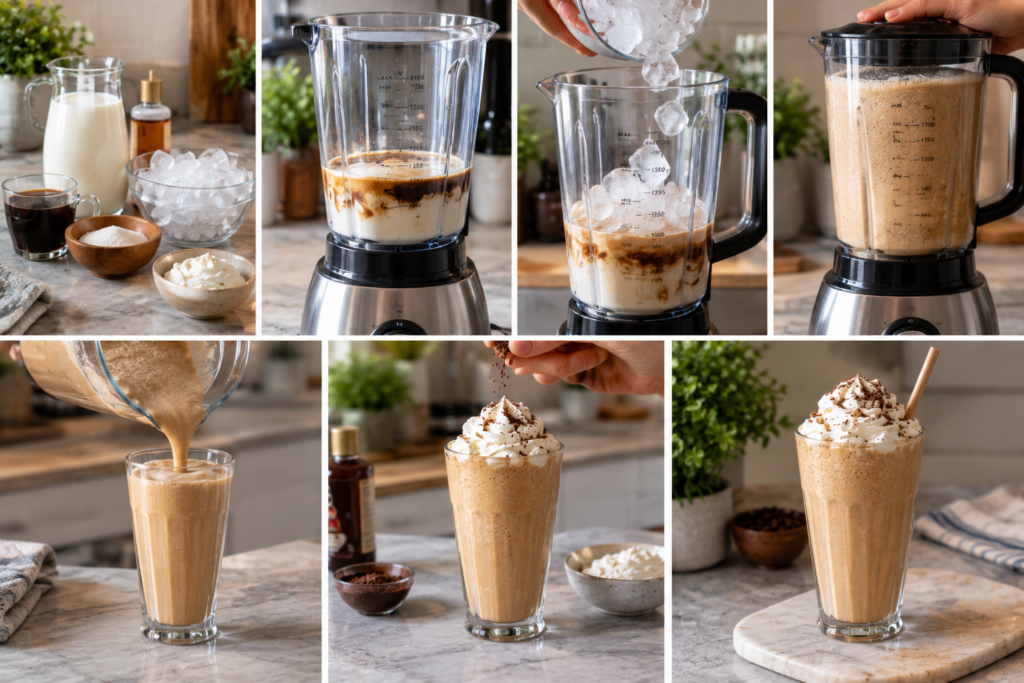
- Add the coffee, milk, sweetener to the blender first
- Add the ice on top
- Blend until it’s smooth and thick, not slushy, and it should look like a milkshake not a smoothie
- Pour into a tall glass
- Top with whipped cream if you’re using it, and serve right away with a straw
One thing we learned the hard way, don’t skip cooling the coffee first. Hot coffee straight into a blender full of ice melts everything and you end up with a watery drink instead of a thick one.
Flavor Variations Worth Trying
Frappes traditionally stay plain, just coffee, sugar, maybe milk. But plenty of modern versions borrow flavor ideas from the Frappuccino side and nothing’s stopping you from doing the same at home:
- Chocolate, a spoon of cocoa powder, chocolate syrup shaken or blended right in
- Vanilla, a splash of vanilla extract, vanilla syrup
- Caramel, drizzled on top or blended through
- Coconut, swap in coconut milk for a completely different base flavor
- Cinnamon, a light dusting on top of either drink works surprisingly well
- Mocha, chocolate and coffee together, popular on the Frappuccino side of things
- Pistachio, a newer favorite that’s shown up on a lot of frappe menus lately, our pistachio frappe is worth trying if you want something a bit different
When we’re experimenting, we add flavoring to the coffee before the ice, so it mixes in far more evenly than trying to stir it in afterward.
Coffee vs Non-Coffee Versions
A frappe is always coffee. That’s not really up for debate, since instant coffee is the entire point of the drink. Take it out, and you basically have flavored sweet water.
A Frappuccino is a different story. Starbucks also sells crème-based Frappuccinos like vanilla bean and strawberry that skip coffee. These are made of a sweetened milk base, having no caffeine, unlike the coffee-based Frappuccinos, which still give you a real jolt. So if you order a Frappuccino and get no caffeine hit at all, nothing has gone wrong. The crème line is simply doing what it was designed to do.
Calories and Caffeine: How They Compare
This is where the two drinks pull apart the most, and it usually comes as a surprise.
| Frappe | Frappuccino | |
|---|---|---|
| Black, no sugar | 5 to 10 calories | Not available in this form |
| With sugar and a splash of milk | 60, 100 calories | N/A |
| Standard 16 oz, coffee-based | N/A | 240 calories average |
| Standard 16 oz, mocha or java chip | N/A | 370-440 calories |
| Caffeine | 60-90 mg | 0-155 mg |
A frappe tends to stay lighter because you decide every ingredient that goes in. There’s no hidden syrup base, no stabilizer, nothing quietly adding sugar unless you choose to add it. A Frappuccino, by contrast, starts out sweet before a single topping is added. Whipped cream by itself can add another 80-110 calories, and a flavor like java chip pushes even higher once the actual chocolate bits get blended in.
When it comes to caffeine, a frappe is the safer bet if you actually want the energy boost. Every version has real coffee in it. A Frappuccino’s caffeine content depends entirely on which flavor you order, and the crème-based ones won’t wake you up at all.
Frappe or Frappuccino: Which One Should You Actually Make?
Go with a frappe if you want something quick yet cheap with that genuinely strong on coffee flavor. It only takes two minutes with almost no equipment and you control exactly how sweet it gets.
Go with a Frappuccino if you’re after something closer to dessert, think along the lines of a cookies and cream style. It takes a bit more setup, a decent blender helps a lot, but you get that thick, creamy texture and endless flavor combinations that a shaken frappe just can’t match.
We tend to reach for a frappe on a regular afternoon and save the Frappuccino setup for when we’re actually in the mood to treat ourselves. Neither one is the “better” drink, as they’re just built for different moods.
FAQs
Is a frappe just a frozen cappuccino?
Not quite. A cappuccino comes from steamed milk and foam served hot. Whereas a frappe is just instant coffee shaken hard with cold water and ice, no machine needed.
Is it pronounced frappe or frap?
It’s “frap-AY,” with the final “e” pronounced, not silent. That’s the standard pronunciation almost everywhere, including in Greece, where the drink comes from.
Is a frappe unhealthy?
It depends on what you put in it, as a simple no-sugar instant coffee frappe sits under 100 calories. If you load it up with condensed milk, whipped cream, then it stops being the light option pretty fast.
Is a frappe just a milkshake?
No. This mix-up happens a lot, mainly in the US where “frappe” sometimes gets used loosely for an ice cream milkshake. An actual coffee frappe has instant coffee, water, ice, shaken until foamy.
Does a Frappuccino always have coffee in it?
No. Starbucks’ crème-based Frappuccinos, like the vanilla bean or strawberries and crème versions, are built on milk and syrup with no coffee at all. If caffeine matters to you, always check whether you’re ordering a coffee-based flavor or a crème-based one.